|
An Architecture for Human Interaction
The basis for our behaviors
|
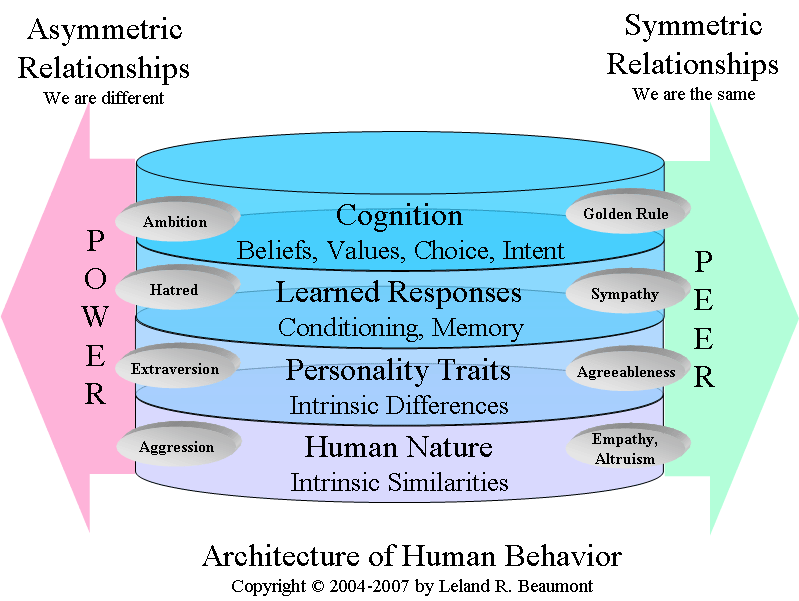
Many factors influence our behaviors. The model illustrated here organizes these factors into four distinct layers and also considers the symmetrical nature of relationships that are currently influencing our behavior. We can easily change some of the factors that lead to our behavior and we can't change others. When analyzing your own behavior or that of others it is helpful to begin by determining which portions of this model are primarily responsible for the behavior.
The first layer, shown creating the foundation at the lowest level, recognizes that we are all human. Ducks quack, dogs bark, but humans speak, and reason, and are driven by our emotions, and share hundreds of universal characteristics regardless of our race or culture. These intrinsic similarities are called human nature. Below this layer, and not shown, is human physiology, describing the physical nature of our bodies.
The second layer recognizes the intrinsic differences that make us each the unique person we are. These are our personality traits. These stable characteristics remain primarily constant throughout our adult life.
The third layer addresses the habits, cultural differences, and even addictions we have learned throughout our lives. These learned responses are the results of classical conditioning, operant conditioning, and other learned associations and they create long term memories that act as limbic attractors to guide our (almost) automatic responses to many situations.
Finally we come to the top layer where our thoughts directly guide our choices. This cognition gives us free will and the ability to choose our actions based on our beliefs, values, goals, motivation, and intent. Our autonomy is within this layer. Perhaps curiosity about layers above this one drives various spiritual pursuits.
At each of these layers, our behavior is also influenced by the nature of the relationships we are acting in. While relationships can have many characteristics, they are organized here according to their power structure, which refers to the symmetry of the relationship, demonstrated by the nature of reciprocity. Peers are equals. If behaviors throughout the relationship demonstrate you are an equal with the other person in the relationship, this is called a peer relationship, and the interactions are largely symmetrical. On the other hand, power is asymmetrical. If you feel you must defer or submit to the other person in the relationship this is called a power relationship, and the interactions are largely asymmetrical. This dimension captures the idea “I am special” at one pole and the idea “We are all the same, we are all connected” at the other pole. This dimension is often so pervasive it becomes almost invisible.
A Story
Bob is a young, single, ambitious, hansom, well educated professional. He is beginning work for a prestigious corporation. His new boss, Susan, is professional, ambitious, drop dead gorgeous, and single. Human nature is a wonderful thing. His selfish genes give him a clear and immediate message: “Your legacy depends on mating her now”.
His personality is introverted, agreeable, conscientious, neurotic, and open to experience. His acquaintances describe him as courteous, devout, honest, and self-sacrificing. Her personality is extroverted, disagreeable, conscientious, emotionally stable, and open to experience. Unfortunately even her friends describe her as aggressive, bigoted, bullying, cocky, and domineering. Can these two personalities possibly result in the elusive chemistry of a romantic relationship? [complete this]
Bob comes from a conservative background and culture. He is the type of polite, considerate gentleman that ensures us chivalry is not dead. He has been consistently taught never to mix romance and business. [Complete this include deeper conditioned behaviors]
Applying this Architecture
As you observe your own behavior, or especially the behavior of others, consider which of these four layers is most responsible for each action. That analysis can help you decide if this is behavior that can change or behavior that cannot change. We cannot change human nature, and we cannot change personalities. It requires a systematic program to extinguish learned responses, so only cognitive choices can be readily changed. Don't waste time trying to change what cannot be changed.
Quotations:
- Our confusion about who we are is certainly related to the fact that we consist of a large set of levels, and we use overlapping language to describe ourselves on all of those levels ~ Douglas R. Hofstadter

References:
How the Mind Works , by Steven Pinker , by Steven Pinker
The Blank Slate: The Modern Denial of Human Nature , by Steven Pinker , by Steven Pinker
|
Fear, Sadness, Anger, Joy, Surprise, Disgust, Contempt, Anger, Envy, Jealousy, Fright, Anxiety, Guilt, Shame, Relief, Hope, Sadness, Depression, Happiness, Pride, Love, Gratitude, Compassion, Aesthetic Experience, Joy, Distress, Happy-for, Sorry-for, Resentment, Gloating, Pride, Shame, Admiration, Reproach, Love, Hate, Hope, Fear, Satisfaction, Relief, Fears-confirmed, Disappointment, Gratification, Gratitude, Anger, Remorse, power, dominance, stature, relationships
|
