What is most important to you? What is not so important? What are your priorities? What really ticks you off? What is worth defending and protecting? How do you choose among conflicting goals? Answering these questions begins to identify your values—enduring beliefs of what is most important to you. Checking the list against the decisions you make and the actions you take reveals much about what you truly hold to be important. Our values establish what goals are more important and what goals are less important to us. Values transcend specific actions and situations and provide us stability and guidance as we encounter obstacles, distractions, opportunities, ambiguity, ambivalence, conflict, and temptations throughout our lives. What are your values? 
Definitions
- What you find most important,
- Intrinsic worth,
- Your standards for judgment and appraisal.
Related Terms
Several English language words describe merit, worth, or importance, including: convictions, ideals, ideology, merit, morality, principles, standards, and worth.
After interviewing 24 courageous and thoughtful men and women of conscience from around the world, author Rush Kidder concluded that eight values are widely, almost universally, accepted. These common values are:
- love (compassion)—Caring for others, helping others,
- truthfulness—honesty, keeping your promises, communicating clearly and accurately, veracity, being trustworthy,
- fairness—following the Golden Rule, equality, symmetry,
- freedom—freedom of expression, freedom from oppression, freedom of action when combined with personal responsibility,
- unity—community, inclusiveness, cooperation, valuing our interdependencies,
- tolerance—acknowledging the dignity of all, respecting the rights of others, refusing to hate, being open to other points of view,
- responsibility—care for yourself, care for others, care for the future, and
- respect for life—do not kill.
In a separate study Christopher Peterson and Katherine Dahlsgaard identified six virtues endorsed across the thinking of many philosophers, religious leaders, statesmen, and other ancient and modern luminaries from around the world. These virtues are: Wisdom and knowledge, courage, love and humanity, justice, temperance, and spirituality and transcendence. Martin Seligman uses these as the basis for identifying signature strengths. uses these as the basis for identifying signature strengths.
For Plato, all virtues were a product of the cardinal virtues of: courage, wisdom, temperance, and justice.
Abraham Maslow identified 16 subtle (easily displaced, vulnerable, fragile, delicate, intricate) values common to self-actualizing people he called Being-Values, or B-Values. These are: wholeness, perfection, completion, justice, aliveness, richness, simplicity, beauty, goodness, uniqueness, effortlessness, playfulness, truth, honesty, reality, and self-sufficiency.
Jonathan Haidt provides further insights. His research shows that we are born with an inherent sense of five foundations for morality. These are: 1) Care for others, do not harm them, 2) Be fair and reciprocate, follow the golden rule, 3) Be loyal to those in your group, cooperate and help group members succeed, 4) Respect authority, 5) Purity and sanctity, practice self control and avoid toxins and filthy behaviors. As we grow toward maturity people universally continue to value the first two of these: care and be fair. However, an important divergence occurs with the last three values. People who are high in the personality trait of “openness to experience”—often characterized as liberal thinkers—reject the last three values. Other people—those who are politically conservative and low in the openness trait—continue to value loyalty, authority, and purity. Both viewpoints are valid and necessary. The conservative viewpoint recognizes the importance of organizing into groups, and those groups require some authority structure and self restraint to make them effective. At the same time, the liberals recognize the value of diversity, the need to challenge authority to effect positive change and overcome oppression, and the importance of personal autonomy. We need the stability of institutions and traditions, along with the chaos of change that moves us toward justice for all.
Neuroscientist and Philosopher Sam Harris believes that choices that improve human well being and help human communities flourish are the better choices, and these can often be objectively identified.
Perhaps the most comprehensive and up-to-date values theory is the Universal theory of human values developed by Shalom H. Schwartz. This theory identifies ten basic values that people in virtually all cultures demonstrate have some persistent level of importance in guiding decision making and choosing actions. These ten values, and the distinct motivation underlying each, are described in the following table.
| Value: |
Motivation: |
Examples: |
| Achievement |
Personal success through demonstrating competence according to social standards. |
Success: Achieving goals.
Capability: Competence, effectiveness, efficiency.
Ambition: Hard work, aspirations.
Influence: Have an impact on people and events. |
| Benevolence |
Preserving and enhancing the welfare of those with whom one is in frequent personal contact (the ‘in-group’). |
Helpful: Working for the welfare of others.
Honesty: Genuineness, sincerity.
Forgivingness: Willingness to pardon others.
Loyalty: Faithful to my friends, group.
Responsibility: Dependable, reliable. |
| Conformity |
Restraint of actions, inclinations, and impulses likely to upset or harm others and violate social expectations or norms. |
Politeness: Courtesy, good manners.
Obedience: Dutiful, meet obligations.
Self-discipline: Self-restraint, resistance to temptation.
Honor parents and elders: Showing respect. |
| Hedonism |
Pleasure and sensuous gratification for oneself. |
Pleasure: Gratification of desires.
Enjoyment in life: Enjoyment of food, sex, leisure, and so on. |
| Power |
Social status and prestige, control or dominance over people and resources. |
Social power: Control over others, dominance.
Authority: The right to lead or command.
Wealth: Material possessions, money. |
| Security |
Safety, harmony, and stability of society, of relationships, and of self. |
Family security: Safety for loved ones.
National security: Protection of my nation from enemies.
Social order: Stability of society.
Cleanliness: Neatness, tidiness.
Reciprocation of favors: Avoidance of indebtedness. |
| Self-Direction |
Independent thought and action; choosing, creating, exploring. |
Creativity: Uniqueness, imagination.
Freedom: Freedom of action and thought.
Independence: Self-reliance, self-sufficiency.
Curiosity: Interest in everything, exploration.
Choose own goals: Select own purposes. |
| Stimulation |
Excitement, novelty, and challenge in life. |
Daringness: Adventure-seeking, risk taking.
A varied life: Filled with challenge, novelty, change.
An exciting life: Stimulating experiences. |
| Tradition |
Respect, commitment, and acceptance of the customs and ideas that traditional culture or religion provide the self. |
Humility: Modesty, self-effacement.
Acceptance of my portion in life: Submission to life’s circumstances.
Devotion: Hold to religious faith and belief.
Respect for tradition: Preservation of time-honored customs.
Moderation: Avoiding extremes of feeling or action. |
| Universalism |
Understanding, appreciation, tolerance, and protection for the welfare of all people and for nature. |
Broadminded: Tolerant of different ideas and beliefs.
Wisdom: A mature understanding of life.
Social justice: Correcting injustice, care for the weak.
Equality: Equal opportunity for all.
A world at peace: Free of war and conflict.
A world of beauty: Beauty of nature and the arts.
Unity with nature: Fitting into nature.
Protecting the environment: Preserving nature. |
Certain pairs of these values are inherently conflicting. For example, the stability of conformity conflicts with the spontaneity of stimulation. The asymmetry of power conflicts with the equality of universalism.
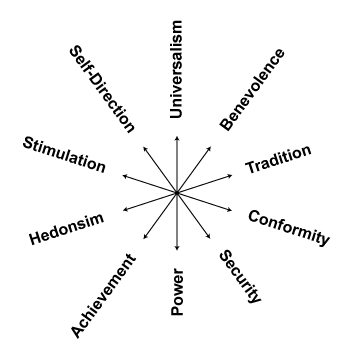 Recognizing the compatibilities and conflicts inherent in these values, the theory arranges them to form a circle as shown here. Conflicting values are shown opposite one another, and the adjacent values are largely compatible. Because of this structure if you choose the value you believe to be most important from the ten listed, then typically you will hold the opposite value lowest, and may attribute it a negative worth. Also, values adjacent to your most important value in the circle will also be quite important to you. The importance decreases the farther removed around the circle, in both directions, from your most important. As a result, your overall values set can be approximately described by simply rotating this circle until your most important value is shown at the top. The circle shown here is oriented to reflect the values of a particularly wise person. Recognizing the compatibilities and conflicts inherent in these values, the theory arranges them to form a circle as shown here. Conflicting values are shown opposite one another, and the adjacent values are largely compatible. Because of this structure if you choose the value you believe to be most important from the ten listed, then typically you will hold the opposite value lowest, and may attribute it a negative worth. Also, values adjacent to your most important value in the circle will also be quite important to you. The importance decreases the farther removed around the circle, in both directions, from your most important. As a result, your overall values set can be approximately described by simply rotating this circle until your most important value is shown at the top. The circle shown here is oriented to reflect the values of a particularly wise person.
When discussing values it is important to be clear about “what's up”—what specific values are considered most important. Sometime careless (or manipulative) speakers will make a general appeal to “uphold values” or “return to values” without identifying the specific values considered important. This ambiguity can be an attractive appeal to a large audience because each listener is naturally thinking about his or her own values (perhaps oriented as show in the figure above). However, the speaker may have in mind a values orientation that may be substantially different, even inverse of yours.
In Buddhism, it is the motivation that counts. The overarching value is genuine compassion for all. An act is unethical if its goal is to cause suffering and it is ethical if it is meant to bring genuine well-being to others.
Before deciding how to act, the Dalai Lama encourages us to ask:
- Are we being broad minded or narrow minded?
- Have we taken into account the overall situation or are we considering only selected information?
- Is our view short-term or long term?
- Is our motivation genuinely compassionate?
- Is our compassion limited to our families, or friends, and those we identify with closely?
After considering these widely-held values perhaps you believe they provide an excellent standard for judging right and wrong, good and bad, important from trivial. Perhaps you believe something else. Knowing yourself requires a careful examination of your own values and beliefs. What are they? How did they originate? What are they based on? Why do you hold these beliefs? Are they based on reliable evidence? Are your actions consistent with your beliefs? How do your beliefs align with your values? How have they evolved over your lifetime? How do they help you live a gratifying life?
Study the theory of knowledge and use it to carefully choose your own values and beliefs.
To begin to create a list of your own values, consider the terms and phrases in the following alphabetical list. Modify, clarify, or add to the list as you like to make it meaningful to you. Choose the five to ten terms that describe what is most important to you. Carefully examine and introduce verbs as appropriate in each values statement to make it active, precise, and meaningful to you. For example, the value “Freedom” may become “exercising freedom”, “defending freedom”, “providing freedom", “expanding freedom”, or some other phrase that more precisely describes your particular values. Ask close friends if the list agrees with how they know you. Examine how your goals, beliefs, and actions align with these values.
Values can become statements of high level goals. People may say “I believe in freedom” when more precisely they mean “I believe in the value of freedom” or “Freedom is an important value for me” or “Freedom is an important goal that I work to achieve”.
Acceptance, Accomplishment, Achievement, Active lifestyle, Advancement and promotion, Adventure, Aesthetics, Affection (love and caring), Affiliation, Aliveness, Altruism, Appreciation, Arts, Aspiration, Assertiveness, Attentiveness, Authenticity, Authority, Autonomy, Avarice, Awareness.
Balance, Beauty, Benevolence, Betterment, Bravery, Boldness
Care free, Caring, Caution, Challenge, Chaos, Challenging problems, Change and variety, Charity, Chastity, Citizenship, Clarity, Cleanliness, Close relationships, Congruence, Contemplation, Comfort, Commitment, Community, Compassion, Competence, Competition, Completion, Congruence, Confidence, Conflict, Conquest, Conservation, Consideration, Consistency and order, Contentment, Contribution, Control, Cooperation, Courage, Country, Courtesy, Craftsmanship, Creativity, Critical thinking, Cruelty, Cultural Identification, Cunning, Curiosity
Danger, Decisiveness, Dedication, Democracy, Deference, Dependability, Detachment, Determination, Dignity, Diligence, Discernment, Discipline, Discretion, Dominance, Drive, Duty
Ecological awareness, Economic security, Education, Effectiveness, Efficiency, Effortlessness, Ego, Elegance, Emotional Intelligence, Empathy, Endurance, Enjoyment, Enthusiasm, Equanimity, Ethnic identification, Ethical practice, Excellence, Excitement, Exhibition, Expertise
Faith, Faithfulness, Fairness, Fame, Family, Fast living, Fidelity, Financial gain, Financial Security, Fitness, Flexibility, Flow, Foresight, Forgiveness, Fortitude, Fortune, Freedom, Free will, Friendliness, Friendships, Frivolity, Fulfillment, Fun
Generosity, Gentleness, Genuineness, Gluttony, Goodness, Gratification, Gratitude, Greed, Growth
Happiness, Hate, Having a family, Health, Hedonism, Helpfulness, Helping society, Heritage, Heroism, Honesty, Honor, Hope, Hospitality, Humanity, Human Rights, Humility, Humor
Idealism, Ignorance, Imagination, Impartiality, Impulse, Independence, Individuality, Indulgence, Industry, Influencing others, Ingenuity, Inner harmony, Innovation, Integration, Integrity, Intellectual Intelligence, Intellectual stature, Intellectual stimulation, Interpersonal contact, Innovation, Insight, Intuition, Involvement
Job Satisfaction, Job tranquility, Joy, Justice
Kindness, Knowledge
Liberty, Lightheartedness, Leadership, Learning, Legacy, Leisure, Location, Logic, Love, Loyalty, Lust
Macho, Magnanimity, Market position, Mastery, Meaning, Meaningful work, Mercy, Merit, Meritocracy, Moderation, Modesty, Money, Morality
Nature, Nonviolence, Now, Nurturing
Obedience, Openness, Optimism, Order(tranquility, stability, conformity), Originality
Pacifism, Parsimony, Passion, Patience, Patriotism, Peacefulness, Peace of mind, Perfection, Perseverance, Persistence, Personal development, Personal Freedom, Perspective, Philanthropy, Physical challenge, Piety, Playfulness, Pleasure, Positivity, Power and authority, Prayerfulness, Prestige, Privacy, Progressivism, Prudence, Public service, Purity, Purposefulness
Quality of what I take part in, Quality relationships, Quality of Life.
Rationality, Reality, Rebellion, Reciprocity, Recognition (respect from others, stature), Reflection, Relatedness, Relaxation, Reliability, Religion, Reputation, Resilience, Respect, Respect for life, Restraint, Responsibility and accountability, Revenge, Reverence, Richness, Righteousness, Risk Taking
Sacrifice, Safety, Security, Self-actualization, Self-awareness, Self-confidence, Self-control, Self-discipline, Selfishness, Self-reliance, Self-respect, Self-sufficiency, Self-worth, Sensitivity, Sensory pleasure, Serenity, Service, Sharing, Significance, Simplicity, Sincerity, Sloth, Sobriety, Social skills, Sophistication, Spirituality, Stability, Status, Stature, Steadfastness, Strength, Supervising others, Symmetry
Tactfulness, Teamwork, Temperance, Tenacity, Thankfulness, Thrills, Time freedom, Tolerance, Tradition, Tranquility, Transformation, Transcendence, Trust, Trustworthiness, Truth, Truthfulness, Tyranny
Understanding, Uniqueness, Unity
Valor, Variety, Vigor, Violence, Vision
Wealth, Whimsical, Wholeness, Will, Winning, Wisdom, Wonder, Woo, Work under pressure, Work with others, Working alone, World Peace
Zest.
Quotations:
- “Unless we stand for something, we shall fall for anything.” ~ Peter Marshall
References
Shared Values for a Troubled World: Conversations With Men and Women of Conscience , by Rushworth M. Kidder , by Rushworth M. Kidder
The real difference between liberals and conservatives, Jonathan Haidt on TED.com
The Righteous Mind: Why Good People Are Divided by Politics and Religion , by Jonathan Haidt , by Jonathan Haidt
Ethics and the Golden Rule , by Harry J. Gensler , by Harry J. Gensler
Values That Various People Have Associated With Wisdom
Basic Human Values: An Overview by Shalom H. Schwartz The Hebrew University of Jerusalem
Happiness: A Guide to Developing Life's Most Important Skill , by Matthieu Ricard , by Matthieu Ricard
A Rose by Any Name? The Values Construct, by Meg J. Rohan, School of Psychology University of New South Wales, Personality and Social Psychology Review, 2000, Volume 4, Number 3.
Science can answer moral questions, Sam Harris, February 2010, TED.com
The World Values Survey website
Declaration toward a global ethic, Parliament of the World's Religions, September 4, 1993
|

