|
Responsibility
My Role
Having responsibility is the duty or obligation to act. Taking responsibility is acknowledging and accepting the choices you have made, the actions you have taken, and the results they have led to. True autonomy leads to both having responsibility and taking responsibility. Taking responsibly is fulfilling your role in life. Responsibility is an essential element of integrity; it is the congruence of what you think, what you say, and what you do. Responsibility is essential for reciprocity, trust, and for maintaining symmetric relationships.
Definitions
- Having a duty or obligation to act
- Acknowledging and accepting the choices you have made, the actions you have taken, and the results they have led to.
- Able to meet commitments made to yourself and others
- Keeping the promises you make.
- Doing everything you say you will do, or have lead others to expect from you. Do what you say!
Responsibility is a Choice
Responsibility without choice is torment. This is the tragic curse suffered by scapegoats and other innocent people falsely accused and wrongly blamed. Choice without responsibility is greed. This is the selfish attempt to get something for nothing that is the wasteful and harmful excess of cheaters, playboys, egotists, and tyrants. Escaping responsibility is at the root of the tragedy of the commons . Taking responsibility for our choices provides the symmetry of reciprocal exchange and the basis for trust. Responsibility is a congruence between the actions we choose and our values. . Taking responsibility for our choices provides the symmetry of reciprocal exchange and the basis for trust. Responsibility is a congruence between the actions we choose and our values.
Responsibility unleashes choice. Whenever we think, decide, choose, and act we are exercising our personal responsibility. Deciding to accept responsibility for our choices increases the range of choices considered acceptable by others. It allows autonomy to increase without decreasing relatedness. We always have more responsible and less responsible options to choose from. Here are examples of choices we have:
| More Responsible |
Less Responsible |
| Facts, realism, reality, and learning what is. Inquiring, investigating, seeking, and embracing facts and truth. Reason and sanity. |
Fantasy. Avoiding reality; embracing fantasy or magical thinking. Denying or escaping reality. Rumors. Rejecting facts. Insanity. |
| Honesty. |
Dishonesty. |
| Focusing our thoughts and attention. Orderly. |
Drifting, rambling, unfocused, flighty, chaotic. |
| Thinking through alternatives and consequences. |
Relying on habit or taking the easy way. |
| Clear and consistent thinking and expression. |
Obscurity, vagueness, hedging, inconsistency, waffling. |
| Learn from history. |
Revise, ignore, or dispute history. |
| Seeking out expertise. |
Dismissing expertise. |
| Working to understand. |
Whatever. |
| Self-discipline. Impulse control. Behaving true to your values. Saying “yes” to your values and “no” to the rest. |
Acting on impulse. Going along with whatever. Situational ethics. |
| Do what you say. |
Do whatever. |
| Fulfill reciprocal obligations. |
Evade reciprocal obligations. Cheat. |
| Open to new ideas and information. Curious. Wise. |
Closed to new ideas. Stubborn and closed minded. Ignorant. |
| Willing to accept blame for errors. |
Infallible, arrogant, dismissive, obstinate. |
| Consistent, congruent, and reliable. |
Inconsistent, chaotic, unreliable. |
| Rationality, valuing reason, respect for facts, and valid logic. Gathering, validating, and studying evidence. Developing and applying a coherent theory of knowledge. |
Fallacies, distortions, assumptions, misinformation, and unrepresentative data. |
| Considering a variety of points-of-view. |
Accepting a one-sided view. |
| Rigorous, careful, attentive. |
Sloppy, careless, distracted. |
| Adaptation and flexibility. Adjusting beliefs and actions to accommodate newly understood facts. |
Rigid and misfit. |
| Competence. |
Manipulation. |
| Autonomy. |
Dependence. |
| Courage. |
Cowardice. |
| Seeking solutions. |
Assigning blame. |
| Integrity. |
Betrayal. |
| Awareness and wisdom. |
Unawareness and ignorance. |
| Adherence to evidence, values, and choice. |
Blind obedience. |
| Entrepreneurship. |
Bureaucracy |
| Participant. |
Bystander. |
| Entitled to my own opinion. |
Entitled to my own facts. |
| Talking to people. |
Talking about people. |
| Building enduring relationships based on who we are. |
Seeking instrumental relationships based on what we do. |
I choose to . . .
I decided to . . . |
I had to . . .
I had no choice . . . |
| Ideas, choices, and actions do matter and do have consequences. Believing that effects and outcomes have causes. |
It's all up to fate, destiny, and chance. Attributing results to chance or destiny. There is noting I can do; I am helpless. |
| Internal Locus of Control |
External Locus of Control. |
Responsibility requires Autonomy
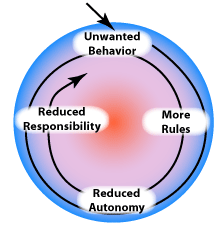 Responsibility requires autonomy. We can only feel accountable and be held accountable for the choices we make for ourselves. Free choice is only possible when we are autonomous. As autonomy increases, responsibility increases with it. However, when autonomy is reduced, responsibility is reduced along with it. This leads to an unfortunate and all too common destructive spiral when one person or agency imposes arbitrary rules in an attempt to control another. But arbitrarily imposed rules reduce autonomy, and therefore reduce responsibility. Management, parents, teachers, agencies, partners, governments, organizations, and others often attempt to increase control by increasing the number of rules. But this increase in rules decreases autonomy which reduces responsibility. Arbitrary rules remove responsibility. This is the failure of “micro management”; the target is frustrated by all the silly rules, and the manager is frustrated by the negative response, disengagement, and overall poor results. Treating adults like children by imposing arbitrary rules that destroy autonomy often encourages them to act like irresponsible children. This degenerative spiral is illustrated here. It illustrates how submitting to authority reduces the sense of responsibility. To reverse this spiral, increase responsibility by increasing autonomy. Responsibility requires autonomy. We can only feel accountable and be held accountable for the choices we make for ourselves. Free choice is only possible when we are autonomous. As autonomy increases, responsibility increases with it. However, when autonomy is reduced, responsibility is reduced along with it. This leads to an unfortunate and all too common destructive spiral when one person or agency imposes arbitrary rules in an attempt to control another. But arbitrarily imposed rules reduce autonomy, and therefore reduce responsibility. Management, parents, teachers, agencies, partners, governments, organizations, and others often attempt to increase control by increasing the number of rules. But this increase in rules decreases autonomy which reduces responsibility. Arbitrary rules remove responsibility. This is the failure of “micro management”; the target is frustrated by all the silly rules, and the manager is frustrated by the negative response, disengagement, and overall poor results. Treating adults like children by imposing arbitrary rules that destroy autonomy often encourages them to act like irresponsible children. This degenerative spiral is illustrated here. It illustrates how submitting to authority reduces the sense of responsibility. To reverse this spiral, increase responsibility by increasing autonomy.
Various appeals such as loyalty oaths or calls to faith are often used in an attempt to sustain personal responsibility as people are asked to tolerate, accept, and obey arbitrary rules. Be alert to these, judge for yourself if they are manipulative, and carefully evaluate what you are being told and asked to do. Decide for yourself what you believe, what you accept, what you value, and what you are willing to do.
When rules are understood as a reasonable means toward achieving a goal they can help increase autonomy rather than decrease it. We understand the value of driving on the right (or left, depending on your country) and stopping at red lights because these simple rules promote order and help keep us safe. We understand that waiting our turn in line provides fair and orderly access. We choose to obey these helpful rules. Committees and well-run organizations choose to adopt rules that help each person better contribute to the shared goals, meet the reasonable expectations of others, and perform better as a group. If the purpose for the rule is understood and judged to be reasonable and valuable then the rule is adopted voluntarily. The rule becomes integrated. In this case the rule increases order and improves results without reducing autonomy or responsibility.
Dispersion and Focus
There is an unfortunate tendency for an individual to seek increasing authority and focus it on themselves while dispersing responsibility throughout an organization and avoiding it themselves. This is especially true in a typical bureaucracy. The frustrating statement: “I am in charge of this but I can't help you with that” is all too typical in a bureaucracy. This allows an individual to increase their power by constraining the activities of others, while providing themselves with a way to avoid difficult decision making, distribute blame, and avoid accountability. As a defense, to increase accountability, those that must rely on performance of a bureaucracy seek to focus responsibility and disperse authority.
Optimism and Responsibility
Optimists tend to take responsibility for good outcomes and blame other causes for bad outcomes. Pessimists blame themselves when things go wrong. The truth often exists somewhere between these two extremes. Be flexible and choose accurate explanations that fit the evidence.
Irresponsible Gambits
Many people are very skillful in disguising or obscuring the responsibly they hold for the choices they make and the actions they take. Here are some of the most common tricks:
Playing the Victim
You are playing the victim and shirking your responsibility when you are acting like you have no choice, choosing to remain powerless, declining to act, blaming others, or failing to see constructive alternatives. These are all ways to “play the victim” and deny the responsibility you can take. “But what can I do?” is the typical victim’s disingenuous protest as they act helpless and decide to do nothing.
Blaming the Victim
Often the poor are blamed for their poverty, battered spouses and children are blamed for causing their own abuse, and rape victims are accused of “asking for it”. Instead of blaming the victim, look more deeply and more broadly for the true causes of the problems. Blaming the victim distracts attention from the true cause and attempts to shift responsibility. It is a form of scapegoating.
Adults Act Responsibly
Adults act responsibly, children do not, regardless of how long they may have lived.
Adults:
- Control impulses and act deliberately according to their values, well chosen beliefs, and long term goals,
- Consider the needs of others and the community, not only themselves,
- Are generous rather than selfish, kind rather than cruel, gratified, not greedy,
- Are comfortable with complexity, doubt, and ambiguity, they are not quick to judge,
- Control their emotions and don't tolerate tantrums, anger displays, self-indulgence, and violence,
- Are emotionally competent and apply a robust theory of knowledge,
- Integrate experiences and information to act rationally, consistently, and reliably rather than unpredictably, inconsistently, irrationally, and erratically. Adults are stable, even tempered, and non-volatile.
- Are patient and consider the long term, not only this fleeting moment,
- Speak with candor and don't tell lies, speak disingenuously, or mislead,
- Are trustworthy, not manipulative; respect others and play by a fair set of rules. Children often cheat and expect to win at any cost.
- Choose wisdom over ignorance,
- Value reason over power, the pen over the sword,
- Confront problems and transcend conflict, rather than deny and avoid problems, instigate quarrels, become vindictive, or seek revenge,
- Accept responsibility for their actions, admit mistakes, accept their share of the blame, and apologize to others,
- Accept and assimilate facts, rather than dismiss, distort, ignore, spin, self-justify, or fantasize,
- Maintain a balanced perspective; adults tolerate trivial transgressions while courageously upholding the most vital principles,
- Attain an authentic humility and keep their egos in check.
- Are authentic, not phony,
- Are autonomous, competent, and value their interdependence with others,
- Are helpful, not helpless.
- Are sober, not strung-out,
- Enjoy fun, but never at the expense of others.
Our world requires adult supervision; take responsibility to act your age. Children choose easy over hard, simplistic over complex, and fast over slow. But significant contributions are often difficult, complex, and slow to achieve. Forego the cheap thrills to achieve satisfaction and significance. You are a competent, autonomous adult. You are fully responsible for all your words and actions, as are other competent adults; it is time to put away childish things.
A Central Role
Many emotions reflect how we attribute responsibility. We are especially quick to assign blame, often attempting to dispose of our loss. Here are examples of emotions related to attributing responsibility:
- Assigning responsibility for a loss is the definition of blame.
- Pessimists blame themselves for bad outcomes.
- Pessimism contributes to depression.
- Optimists blame others for poor results, but claim responsibly for good outcomes.
- Optimism is the basis for hope.
- Shame results from taking personal responsibility for not meeting your own expectations.
- Guilt results from taking personal responsibility for not meeting another's expectations.
- Revenge and resentment seek to hold others responsible and accountable for your loss.
- You accept responsibility for causing another's loss when you apologize to them.
- Forgiveness frees others from responsibility for your future well-being.
- Hate blames the enemy and holds them responsible for your troubles.
- Sadness turns into anger if you blame someone for your loss.
- You feel betrayed if someone does not meet the responsibilities you expect of them.
- Compassion turns into contempt if you blame the person and hold them responsible for their hardships.
- Reciprocity acknowledges our responsibility for maintaining symmetry in relationships.
- Autonomy is taking full responsibility for your own decisions.
But because another's intent can never be accurately attributed, responsibility often remains ambiguous, and the resulting emotions may not be sending reliable information.
Quotations:
- “We've gotten to the point where everybody's got a right and nobody's got a responsibility.” ~ Newton Minow.
- “With great power comes great responsibly.” ~ Voltaire
- “With freedom comes responsibility.” ~ Edward Deci
- “The price of greatness is responsibility.” ~ Winston Churchill
- “Responsibility—true responsibility—requires that people act autonomously in relation to the world around, that they behave authentically on behalf of some general good.” ~ Edward Deci
- “The disappearance of a sense of responsibility is the most far-reaching consequence of submission to authority.” ~ Stanley Milgram
- “Where respect says ‘Don't hurt’, responsibility says ‘Do help’.” ~ Thomas Lickona
- “Do what you say.” ~
- “Responsibility without choice is torment. Choice without responsibility is greed.” ~ Leland R. Beaumont
- “Citizens are grown-ups. Consumers are kids.” ~ Benjamin R. Barber.
- “When I was a child, I spoke as a child, I understood as a child, I thought as a child: but when I became a man, I put away childish things.” ~ St. Paul in the New Testament.
References
Six Pillars of Self-Esteem , by Nathaniel Branden , by Nathaniel Branden
Consumed: How Markets Corrupt Children, Infantilize Adults, and Swallow Citizens Whole , by Benjamin R. Barber , by Benjamin R. Barber
|
Fear, Sadness, Anger, Joy, Surprise, Disgust, Contempt, Anger, Envy, Jealousy, Fright, Anxiety, Guilt, Shame, Relief, Hope, Sadness, Depression, Happiness, Pride, Love, Gratitude, Compassion, Aesthetic Experience, Joy, Distress, Happy-for, Sorry-for, Resentment, Gloating, Pride, Shame, Admiration, Reproach, Love, Hate, Hope, Fear, Satisfaction, Relief, Fears-confirmed, Disappointment, Gratification, Gratitude, Anger, Remorse, power, dominance, stature, relationships
|
