We feel guilt when others have reason to think poorly of us. We are guilty when we harm others, we feel guilty when we recognize that harm. Guilt encourages us to obey the golden rule and act compassionately. Guilt is the emotion that reflects a decrease in our social standing, while shame reflects a decrease in stature.
Definitions
- Feeling badly about your actions.
- Failure to meet another's standard of behavior.
- Transgressing a moral imperative.
- Having empathy but not acting from empathy.
- Dissatisfaction from our assessment of a decrease in social acceptance or contribution.
- Failing to act on compassion; failing to prevent harm to an unfortunate person.
- Not meeting your responsibility to others.
Root: from Middle English gilt, from Old English gylt, crime.
Guilt is closely related to, but distinct from shame. While shame is a failure to meet your own standards of behavior, guilt is a failure to meet other's standards of behavior. Guilt tell us “you have harmed another, you have not been compassionate, you have ignored the golden rule” while shame tell us “you have not done your best.” Shame is personal, while guilt is public. Shame reflects on the “human being”, and guilt reflects on the “human doing”. Guilt is about what you did, while shame is about you and who you are. Guilt is about what they think, shame is about what you think.
Related Terms:
A few words in our vocabulary describe forms of guilt. These include: feeling sorry, regret, and remorse. Also, it is important to make the distinction between being “judged guilty” by the legal system and “feeling guilty” because you believe you have acted badly. The discussion in these pages is about “feeling guilty”. “Survivor's guilt” refers to feeling badly because you escaped a misfortune, perhaps by chance, that others in your group have suffered.
Origins, Archetypes, and the Plot of Guilt
Guilt guides us in gaining the approval of a group by acting according to their social values. It also motivates us to help others. This strengthens the community by promoting fair exchange.
Coping
The expected response to guilt is to apologize and make amends. Harmful mental states related to guilt can be extinguished by appreciating the full scope of your achievements and recognizing that a single failure is only one event in your life’s experience and contributions.
Benefits and Dangers of Guilt
Guilt promotes socially desirable behavior. It is an intrinsic punishment for socially or morally unacceptable behavior. It provides an incentive (in the form of a negative sanction) for working to become more socially acceptable by punishing us for being socially unacceptable. It reaffirms our feeling of empathy while reminding us to act from empathy.
The Paths of Guilt
Understanding what can trigger our guilt, what separates shame from guilt, and how we can resolve our guilt helps us to cope with our feelings. The following figure illustrates choices we have and paths we can take to either prolong or resolve our guilt. Use this like you would any other map: 1) decide where you are now, 2) decide where you want to go, 3) choose the best path to get there, and 4) go down the chosen path.
You may wish to print out this one-page version of the Paths of Guilt and Shame map.
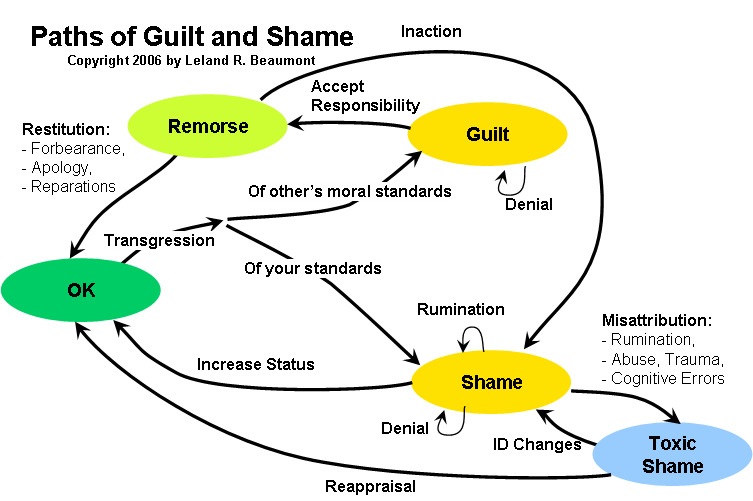
This diagram is an example of a type of chart known by systems analysts as a state transition diagram. Each colored elliptical bubble represents a state of being that represents the way you are now. The labels on the arrows represent actions or events and the arrows show paths into or out of each state. You are at one place on this chart for one particular relationship or incident at any particular time. Other people are likely to be in other places on the chart. This is similar to an ordinary road map where you plot where you are now, while other people are at other places on the same map. Begin the analysis at the green “OK” bubble, or wherever else you believe you are now.
OK: This is the beginning or neutral state. It corresponds to yourself being free of guilt or shame. The green color represents safety, tranquility, equanimity, and growth potential.
Transgression: Something happens that can lead to guilt or shame. The nature of the transgression forms the distinction between shame and guilt. A failure to meet your own standards of behavior; a dissatisfaction based on your own assessment of a decrease in stature leads to shame. Failing to meet the moral standards of others leads to guilt. If you accept the relevant moral standard as your own, then you can also feel shame about your guilt.
Guilt: You feel bad because you have acted against the expectations of another person or group. You failed to meet your responsibility to others. The yellow color represents the dangers you can face and cautions about the choices you can make.
Accept Responsibility: The only path out of guilt is to acknowledge your error and feel remorse; understand what you did wrong, understand why it is a transgression of moral standards, and take responsibility for your role in causing the damage.
Remorse: You feel genuinely bad about the hurt you have caused and you take responsibility for the hurtful choices you made. You assess what has happened and your thinking transforms as you reconcile what you did, what you believe, and what you learned. The greenish color acknowledges remorse can be only one step away from a resolution while the yellowish color recognizes that a full restitution is still required.
Restitution: The only path out of remorse are the three steps of restitution: 1) it begins with forbearance—the resolve to improve and avoid the mistake in the future—followed by 2) a sincere apology, and 3) appropriate reparations to any injured parties.
Inaction: If you feel remorse, yet fail to effectively apologize, and make restitution then you will feel shame and the injured party will remain unsatisfied. It is time to get on with the apology.
Denial: Denial, excuses, self pity, and blame only prolong the agony. You cannot change what you do not acknowledge. Why are you feeling badly? Analyze the transgression, decide what you truly believe, gather evidence and accurately evaluate your behavior, identify the choices you made and the responsibility you have, and get on with the process of restitution. If the guilt persists, it is probably because you are persisting in denial and are not taking responsibility, feeling remorse, and making effective restitution.
Nonverbal Expressions
Westerners often turn away, look down, or divert their eyes when feeling guilty.
Primal Messages
Typical response to guilt sends the primal messages of: ashamed, contrite, apologetic, concerned
Quotations:
- “Remorse cannot be coerced, it has to be discovered.” ~ Leland R. Beaumont
References
[laz] Passion and Reason: Making Sense of Our Emotions, by Richard S. Lazarus, Bernice N. Lazarus
On Apology , by Aaron Lazare , by Aaron Lazare
[Ekm] Emotions Revealed: Recognizing Faces and Feelings to Improve Communication and Emotional Life , by Paul Ekman , by Paul Ekman
The Cognitive Structure of Emotions , by Andrew Ortony, Gerald L. Clore, Allan Collins , by Andrew Ortony, Gerald L. Clore, Allan Collins
[Gol] Destructive Emotions: A Scientific Dialogue with the Dalai Lama , by Daniel Goleman , by Daniel Goleman
Nonviolent Communication: A Language of Life: Create Your Life, Your Relationships, and Your World in Harmony with Your Values , by Marshall B. Rosenberg, Arun Gandhi , by Marshall B. Rosenberg, Arun Gandhi
|

