Trouble is brewing, but you are convinced it can all turn out well. You believe with all the depths of your being that things will get better. You have hope; and you are doing things to improve your future. You are fearing the worst but expecting the best. Hope is the antidote to the hopelessness of despair. Hope moves us forward.
Definitions
 The possibility that things will get better, The possibility that things will get better,- The chance for improvement,
- A positive stance on the future
- Anticipation of a future desirable event or outcome,
- Pleased about a prospective desirable event
Related Terms
Aspire, believe, desire, long for, optimism, eager, and wish are synonyms for hope.
Origins and Benefits:
Hope fuels the human spirit. It drives us forward, encourages us to overcome obstacles, and keeps us focused on achieving worthwhile goals. It encourages imagination and risk-taking and can lead to positive transformations.
False Hope
There is controversy over the concept of “false hope”. If you hold out hope for something that is truly impossible, or so unlikely it is eventually impossible, you may be having false hope. Is this good or bad? To make the distinction, determine if your behavior is beneficial or not. As an example, deciding to spend your food money to play the lottery in the hope you will win is almost certainly destructive and regrettable. The chances of winning the lottery are vanishingly small, and the need for food is certain. Here a “false hope” leads to a destructive behavior and is harmful. Another example is the decision of a high school student to abandon academic studies to concentrate on playing professional sports or becoming a rock musician. The odds against success are astronomical, yet the loss is certain. This is almost certainly a bad bet. However, if you have been diagnosed with terminal cancer, hope can give you peace of mind, relieve stress, and provide you the positive outlook and motivation that can lead to helpful actions including eating well, getting the recommended exercise, taking medications as instructed, seeking out the best care for yourself, peace of mind, and spending time in meaningful ways.
Most “con games” are based on creating false hopes. This includes most forms of gambling, sweepstakes, get rich quick schemes, risky investments, quack cures, promised miracles, hoaxes, urban legends, mysticism, faith exploitations, and other scams. Many of these are manipulations that exploit distortions in our thinking or other vulnerabilities. Examine the evidence, consider a variety of viewpoints, calculate the odds rationally, and approach such claims with extreme skepticism.
Maintain hope when there is some possibility of a good outcome. Take constructive and responsible action to improve your chances. Do not abdicate your responsibility for caution, skepticism, and action by submitting to unfounded optimism. Hope is helpful when it results in positive action, it is unhelpful if it inhibits action. Plan for the worst as you anticipate the best.
Hope is tested when what if meets what is. Accurate assessment, sound judgment, constructive action, and personal responsibility mark the difference between real hope and false hope.
The Keynote Address at the 2004 democratic national convention was an inspiring speech given by Barack Obama on “The Audacity of Hope” He described many examples where the undaunted strength of people overcame tremendous obstacles to achieve great things. Perhaps there is no false hope, but only hope. He has recently written book The Audacity of Hope: Thoughts on Reclaiming the American Dream on “The Audacity of Hope” He described many examples where the undaunted strength of people overcame tremendous obstacles to achieve great things. Perhaps there is no false hope, but only hope. He has recently written book The Audacity of Hope: Thoughts on Reclaiming the American Dream . .
In any case, strive for an accurate optimism.
The Stockdale Paradox
Admiral James Stockdale was the highest ranking US military officer in the Hoa Loa prisoner-of-war camp during the Vietnam war. He was brutally tortured more than twenty times over the eight years he was imprisoned from 1965 to 1973. During that time he dedicated himself to helping the other soldiers survive the ordeal. Jim Collins, author of the book Good to Great, asked Stockdale how he endured, and who in the camp failed to endure. In answering he said: “This is a very important lesson. You must never confuse faith that you will prevail in the end—which you cannot afford to lose—with the discipline to confront the most brutal facts of your current reality, whatever that may be.”
Jim Collins summarizes this wisdom as the “Stockdale Paradox”:
Retain faith that you will prevail in the end, regardless of the difficulties
and at the same time
Confront the most brutal facts of your current reality, whatever they may be.
Hope and reality combine for a real hope.
Real hope combines a hopeful outlook with a firm grip on reality. This is the substance of commitment.
Each of us approaches a new problem, task, challenge, or opportunity with a particular outlook. This outlook can range from a very positive, hopeful spirit to a very negative, or hopeless stance. Many English language words describe this initial outlook. These words range from hopeful, high hopes, optimistic, open, positive, and favorable to skeptical, pessimistic, doubtful, and hopeless. This outlook is plotted on the vertical axis in the following diagram, ranging from hopeless at the bottom to hopeful at the top.
As we get more involved in meeting the challenge we learn more about the real problems facing us. Our grasp on reality begins to change. As more and more information becomes available, we become better informed and create a more accurate understanding and assessment of the situation. Our viewpoint evolves as we assimilate new information. Alternatively, we may choose to remain uninformed and ignorant, or deny, dismiss, or distort important information. This grasp of reality is plotted on the horizontal axis in the following diagram. It ranges from uninformed or distorted to informed and accurate.
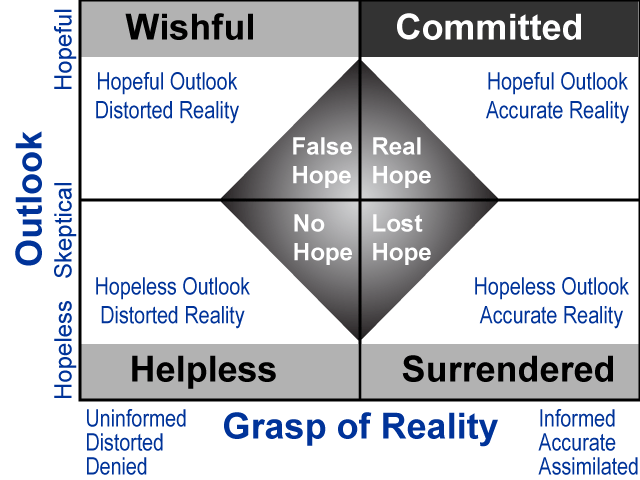
The grid is divided into these four zones:
No Hope—Helpless—Give up now, don't even try, I already know there is nothing I can do to help. Why bother? I won't even waste my time trying; it is futile. This is the region of learned helplessness and the defeatist attitude. The outlook is doubtful and reality is unknown, distorted, denied, or dismissed. Cynics, naysayers, and other gloomy and disheartened people lurk here.
False Hope—Wishful—I have an unshakable faith that all will turn out well. I don't need to know anything more to know it will all turn out fine in the end. This is the heaven's reward fallacy based only on wishful thinking. The outlook is hopeful, but the reality is unknown, distorted, denied, or dismissed. This is often a dangerous position of inaction or ineffective action and little information. It believes hope is a strategy. Visionary dreamers along with Pollyanna's and the crackpots of la-la land are all here.
Lost Hope—Surrendered—The more I learn, the more hopeless this becomes. I cannot overcome the obstacles; further effort is futile. I am discouraged and choose not to go on. I'll save myself for another day. Life is too short to push on a rope. I'll admit defeat and move on to the next challenge, sadder but wiser. The outlook is doubtful, but the reality is accurate. Quitters share this space along with shrewd gamblers, entrepreneurs, and others who decided to retreat now so they can contribute another day.
Real Hope—Committed—I fully understand the difficulties I face and I know I can prevail in the end. I am encouraged and will never give up, despite the difficult challenges that lie ahead. The outlook is hopeful and the reality is accurate. The aspirations of what if meld with the harsh reality of what is to create an enduring result. Tenacious, courageous, persistent, and inspiring people are achieving results here.
We are encouraged when our outlook improves as we learn more about the situation. We are discouraged when our outlook becomes less hopeful as we learn more about the situation. We have dashed hopes when events take us from real hope to lost hope.
Faith, Hope, and Trust
Faith unites hope and trust. Hope is faith that things will get better. Trust is faith I can rely on you. They both are forward looking estimations, and are often based more on intuition than on evidence.
The Scope of Hope
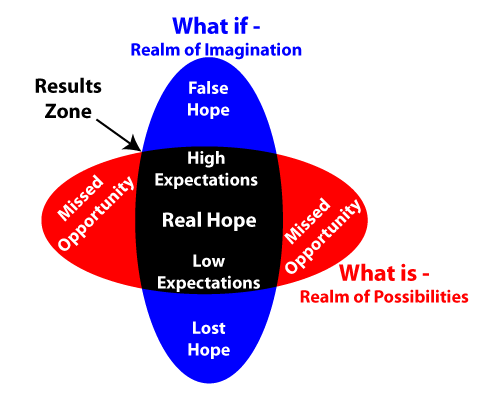
Results depend on how our hopes intersect with reality. Imagination is unrestrained—we can form images of a wide range of possibilities, future outcomes, or results. By asking “what if” we enter the realm of imagination, and our dreams are limited only by our originality, creativity, and spirit. But we live in the real world where what is possible is limited by what is. Our imagination often exceeds the real-world realm of possibilities. We may have pipe dreams that far exceed what is possible. These are false hopes. Alternatively we may have lost hope, become helpless, and stopped imagining a better world. These are lost hopes. Real hope explores the full range of possible outcomes—the results zone. Here our expectations can aim high, as we strive for the best possible outcome, or aim low, as we settle for some mediocre result. Our imagination is finite and we will inevitably miss important opportunities that could have been seized, if only we had imagined them.
The following diagram illustrates these concepts, showing the realm of imagination in blue, the realm of possibilities in red, and the results zone in black. Dream on as you maintain a grasp of reality.
Paths of Hope
Events that can trigger our hope are common occurrences. How we respond to these losses and the choices we make affect our peace of mind, well being, and our lives. The following figure illustrates choices we have and paths we can take to sustain or dash our hope. Use this like you would any other map: 1) decide where you are now, 2) decide where you want to go, 3) choose the best path to get there, and 4) go down the chosen path.
You may wish to print out this one-page version of the Paths of Misfortune map

This diagram is an example of a type of chart known by systems analysts as a state transition diagram. Each colored elliptical bubble represents a state of being that represents the way you are now. The labels on the arrows represent actions or events and the arrows show paths into or out of each state. You are at one place on this chart for one particular interaction at any particular time. Other people are likely to be in other places on the chart. This is similar to an ordinary road map where you plot where you are now, while other people are at other places on the same map. Begin the analysis at the green “OK” bubble, or wherever else you believe you are now.
OK: This is the beginning or neutral state. It corresponds to someone who is feeling well. The green color represents safety, tranquility, equanimity, and growth potential.
Irrevocable loss: You recognize you have lost something valuable and that it is gone forever. You are sad.
Sad: You recognize an irrevocable loss. Perhaps you are crying or tearful. The yellow color represents the loss and pain.
Loss Accepted: When you can turn your thoughts to the future and leave the past behind, you have accepted the loss and can get on with your life.
Loss Denied: Protesting, denying, bargaining, and reliving the past all serve to deny the loss. You are living in the past and not ready to accept the loss. Grieving will continue.
Grieving: Grieving is the struggle to prevent the loss. It is our way of coping with loss and it may involve anger, anxiety, anguish, hope, or guilt. Once the protest and denial is over and the loss is accepted as irrevocable, then grief can turn into sadness and be resolved. Our focus shifts from the past to the future during bereavement. The orange color represents the agony, pain, duration, turmoil, and loss of the grieving period.
Loss Accepted, Future focus: You have decided it is time to get over it, accept the loss, and get on with your life.
Trouble Recognized: You become aware that you can lose something you value. You are worried and dread the possible loss.
Dread: You feel bad because you understand you may lose something. Depending on what it is you stand to lose, you may feel anxious, fear, anger, shame, guilt, envy, or jealousy. The yellow color represents the loss, anxiety, and uncertainty of the time.
Positive Outlook: Although you recognize a bad outcome is possible, you predict a favorable outcome and maintain hope.
Hope: You believe with all the depths of your being that things will get better. You have hope; and you are doing things to improve your future. You are fearing the worst but expecting the best. Hope is the antidote to the hopelessness of despair. The green color represents the positive outlook, while the yellow color represents the uncertainty and possible bad outcome.
Negative Outlook: You predict the worst, and you have lost hope. You become depressed.
Depression: You have lost hope, the future looks bleak, you are depressed and feel hopeless. The red color represents the prolonged pain and ongoing danger of the depression.
Good Outcome: Regardless if you were dreading, hoping, or depressed, you were spared your worst fears and the actual outcome is good. You are relieved.
Relieved: The frustration has changed for the better, and you learn that what you dreaded will not happen, you feel relief. Everything is now much better, you relax and feel a sigh of relief. The green color represents the good outcome and buoyancy of the relief.
Time Passes: The sensation of relief is rather brief. Soon you are back to your ordinary self, looking toward the future.
Bad Outcome: Your fears have come true. Regardless if you were dreading, hoping, or depressed, the actual outcome is bad, and now you are sad.
Quotations
- “Never, never, never, never, never, never, never give up.” ~ Winston Churchill
- “Hope is not a strategy.”
- “The future belongs to those who believe in the beauty of their dreams.” ~ Eleanor Roosevelt
- “It's a poor sort of memory that only works backwards.” ~ Lewis Carroll
- “Know when to hold 'em, and when to fold 'em.” ~ Gambler's wisdom
- “‘Hope’ is the thing with feathers / That perches in the soul” ~ Emily Dickinson
- “Hope is passion for the possible.” ~ Søren Kierkegaard
References
[laz] Passion and Reason: Making Sense of Our Emotions, by Richard S. Lazarus, Bernice N. Lazarus
[Ekm] Emotions Revealed: Recognizing Faces and Feelings to Improve Communication and Emotional Life , by Paul Ekman , by Paul Ekman
[OCC] The Cognitive Structure of Emotions , by Andrew Ortony, Gerald L. Clore, Allan Collins , by Andrew Ortony, Gerald L. Clore, Allan Collins
[Gol] Destructive Emotions: A Scientific Dialogue with the Dalai Lama , by Daniel Goleman , by Daniel Goleman
|

