You hear their words, but are you buying this? Our conversations are most genuine when we begin with well considered thoughts, acknowledge our feelings, are clear and honest about what we want to say and we treat our listeners as respected peers. These are the six essential elements of authentic expression.
Definitions
- Honesty.
- Straight talk.
- Making clear thinking visible.
- Earning trust.
- Common understanding.
- Candor.
- Congruence of intent, thought, feeling, and expression.
Related Terms
Candor, connecting, directness, forthrightness, frankness, genuineness, honesty, impartiality, openness, outspokenness, probity, sincerity, straightforwardness, transparency, truthfulness, uprightness, veracity, true talk, whole words, and straight talk, all refer to important aspects of authentic expression.
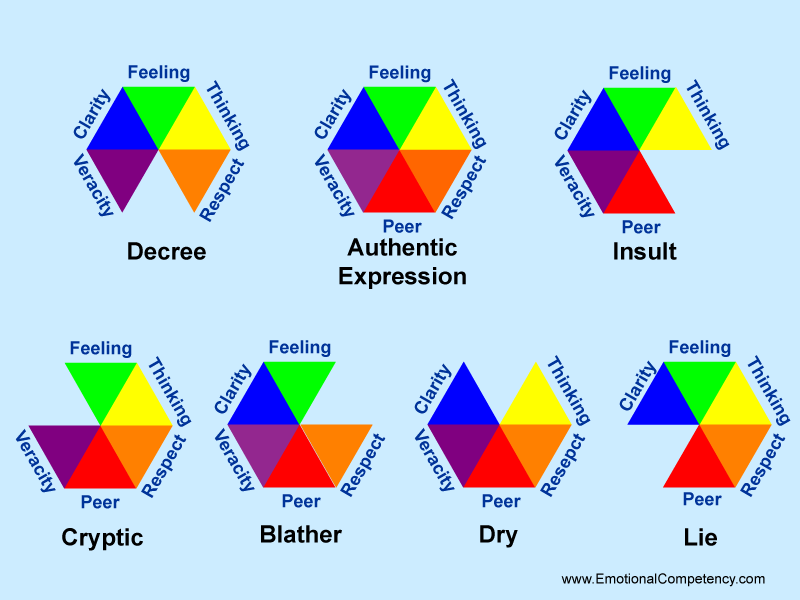
Attributes:
Authentic expression requires attention to the six elements of: Peer Relationships, Respect, Thinking, Feeling, Clarity, and Veracity. Communications with all of these elements help to increase trust in relationships. Each of these elements are described below in detail:
Peer—Equal Power—A symmetrical relationship. When power is balanced between the communicating parties they treat each other as equals and facts, thoughts, opinions, and information can emerge and be considered and examined undistorted by the deference, emphasis, censorship, obedience, and often resentment or rebellion that characterize power differences. The information can be considered on its own merits without anyone being unduly influenced by the stature or reputation of the speaker or intimidated by any threat of harm or repercussions. Information is complete and representative rather than selective, and inquiry is free flowing rather than suppressed or inhibited. Questions are welcome and fully explored and responded to. Dialogue is the only form of communication where the participants act as authentic peers working together toward a shared understanding. It is distinct from the power based forms of communications such as discussion, debate, distraction, dismissal, delegation, disingenuous, diatribe, and dogma. Censorship is also based on power rather than peer relationships. Focus on the facts, not the power stance.
Peer communication can require patience, especially when there is a substantial difference in the background or experiences of the participants. Imagine a conversation between an opera singer and a physicist. If they are discussing a complex opera topic, the opera singer will have to patiently fill gaps in the physicist's understanding of the topic to be able to communicate accurately. This can be difficult to accomplish without seeming to be condescending, stating the obvious, or overlooking pertinent missing background. However don't confuse differences in experience or background for ignorance, stupidity, stubbornness, or status differences.
Respect—Valuing Humanity—Don't be mean. Demonstrate authentic positive attention as you listen, treat others as fellow human beings, and demonstrate your appreciation. Value the intelligence of the listeners. Refrain from any form of unkind remarks including: insult, revenge, ad hominem attacks, barbs, cruel or mean-spirited remarks, sarcasm, unkind jokes, slurs, digs, distortions, put downs, condescension, non-verbal disparagements, attacks, and innuendo. Interrupt the speaker only when it is essential to improve your understanding and advance the conversation. Refrain from nagging, shouting, condescension, and other annoying behavior. Listen carefully to fully understand their point of view. Ask genuine questions to increase your understanding. Address areas of doubt and skepticism. Work to move yourself toward what they understand. Demonstrate sincere appreciation.
Demonstrating respect provides important balance for the other dimensions of authentic expression. For example, it is true but disrespectful and unhelpful to tell your grandmother she looks old. It is usually unwise and disrespectful to emphasize hurtful, disgusting, or especially private information if it is not needed to advance the conversation. Similarly, even though you may be feeling intense anger, it is often best to moderate your public display of the most powerful emotions, and especially violence. While a peer-level exchange of information is essential to healthy dialogue, people who have achieved especially high stature particularly deserve our respect. Strike a balance that ensures both truth and grace with a constructive purpose. Accomplish the task as you strengthen the relationship.
Manage time to demonstrate respect for the people and the importance of the issues. Brevity respects the valuable time of busy people and is often the best choice when the task is paramount. In other circumstances leisurely conversations may be appreciated as generous contributions of your own valuable time, thought, caring, and consideration. These extended, organic, and engaging conversations are best when the relationship is most important or the topic is particularly interesting, sensitive, or complex. Particularly important and difficult issues may require several well-planned, extended, and intense discussions to adequately explore, understand, and address. In any event, match the time spent to the importance of both the task and the relationship.
Thinking—Original, well-founded, congruent, insightful, relevant, and important ideas—Understand your own thoughts, and intentions. Create important, useful, or entertaining original thoughts, ideas, opinions, and questions based on a well founded theory of knowledge. Deliberate, evaluate, contemplate, and decide consistent with your values, beliefs, and goals, as you continue to refine these guiding foundations. The most valuable thoughts are constructive, clear, principled, relevant, and well though-out reflections of your enduring values, beliefs, goals, and concerns. Clear thinking is based on valid logic and accurate research. Think clearly before speaking.
Clear thinking requires us to confront our own inherent ignorance and uncertainty. No one can master the millions of published books, thousands of world cultures, and the ongoing ideas and accomplishments of billions of people. We can only do our best to learn what is most important, remain curious, depend on reliable sources, stay up-to-date in our chosen fields of interest, and make our way through an uncertain world.
Clear thinking is the difficult and essential prerequisite to clear expression.
Feeling—Recognize and acknowledge your emotions—Notice how you feel and express your feelings authentically, both verbally and non verbally, within constructive and compassionate display rules. Speak from the heart without exaggerating or minimizing your emotions.
Clarity—Making ideas visible—Clear communication, sharing understanding, say what you mean. Carefully choose the most accurate words and images to provide the most complete, understandable, and precise representation of your intent. Enunciate clearly, paying attention to accent, inflection, intonation, and sound quality. Speak fluently with eloquence, coherence, and candor. Carefully organize your presentation and write literately, lucidly, and legibly using correct grammar and punctuation. Fully convey your message.
Veracity—The truth, the whole truth, and nothing but the truth—No doublespeak, half-truths, false messages, omissions, spin, innuendo, distortions, dismissals, misrepresentations, confabulations, wishful thinking, grin fakes, or plausible deniability. Veracity requires accurate, complete, and representative facts combined with valid logic and presented in accurate context. Ensure congruence of your word and your intent. Accurate communications avoid distortions and are realistic rather than optimistic or pessimistic. Veracity requires full understanding, acknowledgement, and acceptance of what is—the world as it really exists, not as we wish it was. This is essential for building trust.
Deficits
Communications often lack one or more of these elements. The omissions may be known and deliberate, or the results of an inevitable oversight. These forms of deficient communications decrease trust in relationships. These incomplete communications fall primarily into one of these six major categories:
Insult lacks respect. Synonyms include: attacks, crude language, offense, disrespect, affront, cheap shot, incivility, mockery, put-down, slander, slight, and snub.
Decrees lack the equality and balance of power that characterizes peer relationships. Examples include dogma, dismissals, delegations, pronouncements, diatribe and other forms of indoctrination and posturing. Main stream media reports are another example of power-based communications because the choice of topic, content, attention, and editing is controlled by a few powerful people and the communication is essentially one-way. The superior posture of condescension is not peer based and causes distortions.
Cryptic communications may be well thought out, but lack clear expression. Synonyms include opaque, incoherent, inchoate, Fed speak, vague, nebulous, muddled, garbled, inaudible, illegible, rambling, obscure, disorganized, indirect, inconsistent, baffling, indecipherable, and hazy.
Blather is talking without thinking. Synonyms include gossip and bullshit. Examples include small talk, vamping, bloviating, obscurity, and impulsive or hot headed comments. Please get to the point, and if you don't have a point, stay silent until you do.
Dry communications lack emotional content. This may also be described as bland or sterile. Examples include most technical writing, legal opinions, reference manuals, and much scholarly writing.
Lies lack veracity. This includes any misrepresentation or distortion of reality. There are many examples including fibs, half-truths, misrepresentations, pandering, fabrications, confabulation, falsification, exaggeration, being out-of-touch, avoidance, invalidation, hoax, prevarication, grin-fake, bogus issues, red-herrings, irrelevancies, feigned ignorance, discounting, denial, dismissal, distractions, fantasy, hidden agendas, and sidestepping important issues.
Several forms of communication lack more than one element. These are described in the following chart where the missing elements are absent from the corresponding rows.
| The six elements: |
Peer |
Respect |
Thinking |
Feeling |
Clarity |
Veracity |
| Obfuscation—intentionally obscuring the message—lacks clarity and veracity. |
Peer |
Respect |
Thinking |
Feeling |
Clarity |
Veracity |
| Pitching—advocating a single point of view to promote a special interest—lacks veracity, feeling, and respect. Withholding, misrepresenting, or distorting important alternative viewpoints is dishonest. Often insincere emotions such as joy and excitement are displayed, while doubt is dismissed. The style of communication, inherent distortions, and lack of consideration for more important needs of the audience are often disrespectful. Other examples include evangelizing, persuading, selling, advertising, advocating, fear mongering, lobbying, and charming. |
Peer |
Respect |
Thinking |
Feeling |
Clarity |
Veracity |
| Fawning—appeasing someone because they hold power over you—lacks peer equality, veracity, feeling, and thinking. It is a failure to speak truth to power. Appeasement, yessing, insincere flattery, false praise, kissing up and other failures to speak truth to power are not authentic. They are not peer-based communications because the primary message is submission and obedience rather than accurate and thoughtful feedback on the issue. They lack veracity because they are not accurate expressions of true thoughts and feelings. The feelings expressed are not the emotions actually experienced. The thoughts expressed are dominated by submission, obedience, and fear rather than reflection on the issues. Respect is often lacking because although deference is shown it may not reflect broader and authentic considerations of humanity. |
Peer |
Respect |
Thinking |
Feeling |
Clarity |
Veracity |
| Condescension—pretending to be a peer while believing you are superior—lacks veracity, feeling, respect, and peer attributes. Pretending is dishonest, it does not reflect what you think or what you feel. It is disrespectful because it does not authentically recognize your common human bonds. It is not an equal, peer-based relationship, because you do believe you are superior rather than equal. |
Peer |
Respect |
Thinking |
Feeling |
Clarity |
Veracity |
| Vague Language—an ambiguous message—may result from several deficiencies. It may be a lack of clear expression, or a lack of clear thinking, or a deliberate attempt at deception and evasiveness. It could also result from ambivalent feelings, or conflicts between feeling and thinking. It may be some combination of two or more of these deficiencies. Fuzzy thinking, ambiguous words, conflicting information, complex grammar, obfuscation, and incongruence are all examples of vague language. |
Peer |
Respect |
? |
? |
? |
? |
| Mystique—creating an aura of mystery—withholds clarity and peer relationships to maintain distance and an enhanced image. The mystic must remain separate to remain special. Once he is revealed as just another one of us, the mystique is gone. Feelings that are not authentic may be projected, diminishing the veracity of the feeling dimension of authentic expression. These pretenses can be disrespectful. |
Peer |
Respect |
Thinking |
|
Clarity |
Veracity |
| Demagoguery—Impassioned appeals to prejudices and emotions—evokes strong emotions to distract from faulty thinking. The feelings are overdone, the thinking is weak, the veracity suffers, and the ruse is disrespectful. |
Peer |
Respect |
Thinking |
Feeling |
Clarity |
Veracity |
| Scolding—Finding fault, blaming, and declaring what is right—establishes an adult-child relationship rather than a peer relationship. It lacks respect and peer attributes. |
Peer |
Respect |
Thinking |
Feeling |
Clarity |
Veracity |
| Sarcasm—bitter counterstatement—says the opposite of what you are thinking as it passive-aggressively expresses anger and protest. It lacks respect, and clarity, and denies ownership for angry feelings. |
Peer |
Respect |
Thinking |
Feeling |
Clarity |
|
| Melodrama—exaggerated or unfounded emotional displays—seek to draw unwarranted attention and distort the importance of the message being sent. The feelings displayed are bogus and clarity and veracity are often compromised. |
Peer |
Respect |
Thinking |
Feeling |
? |
? |
Congruence
If the essence of authentic expression can be captured in a single word it is congruence—alignment and agreement. This includes congruence between the intent and the the words, between the thoughts and the intent, between the words and the feelings, between the verbal and non-verbal expression, between the facts and the words, between the words and the actions, and congruence between the speaker and listener as humans who respect each other as equals. Congruence between thinking and representative evidence, goals, beliefs, values, and doubts is especially important to authentic expressions.
Quotations
- Good writing is clear thinking made visible.
- Do what you say.
- Precise and concise.
- “If you can't improve on silence, keep quiet”. ~ Lou Holtz
- “Eschew Obfuscation.”
- “speak about this issue in fair-minded words.” ~ from Barack Obama's Notre Dame Commencement address
 . .
References
How to Use Power Phrases to Say What You Mean, Mean What You Say, & Get What You Want , by Meryl Runion , by Meryl Runion
The Four Agreements, by Don Miguel Ruiz
Telling Lies: Clues to Deceit in the Marketplace, Politics, and Marriage, Paul Ekman
The SPEED of Trust, by Stephen M.R. Covey
On Bullshit , by Harry G. Frankfurt , by Harry G. Frankfurt
|

